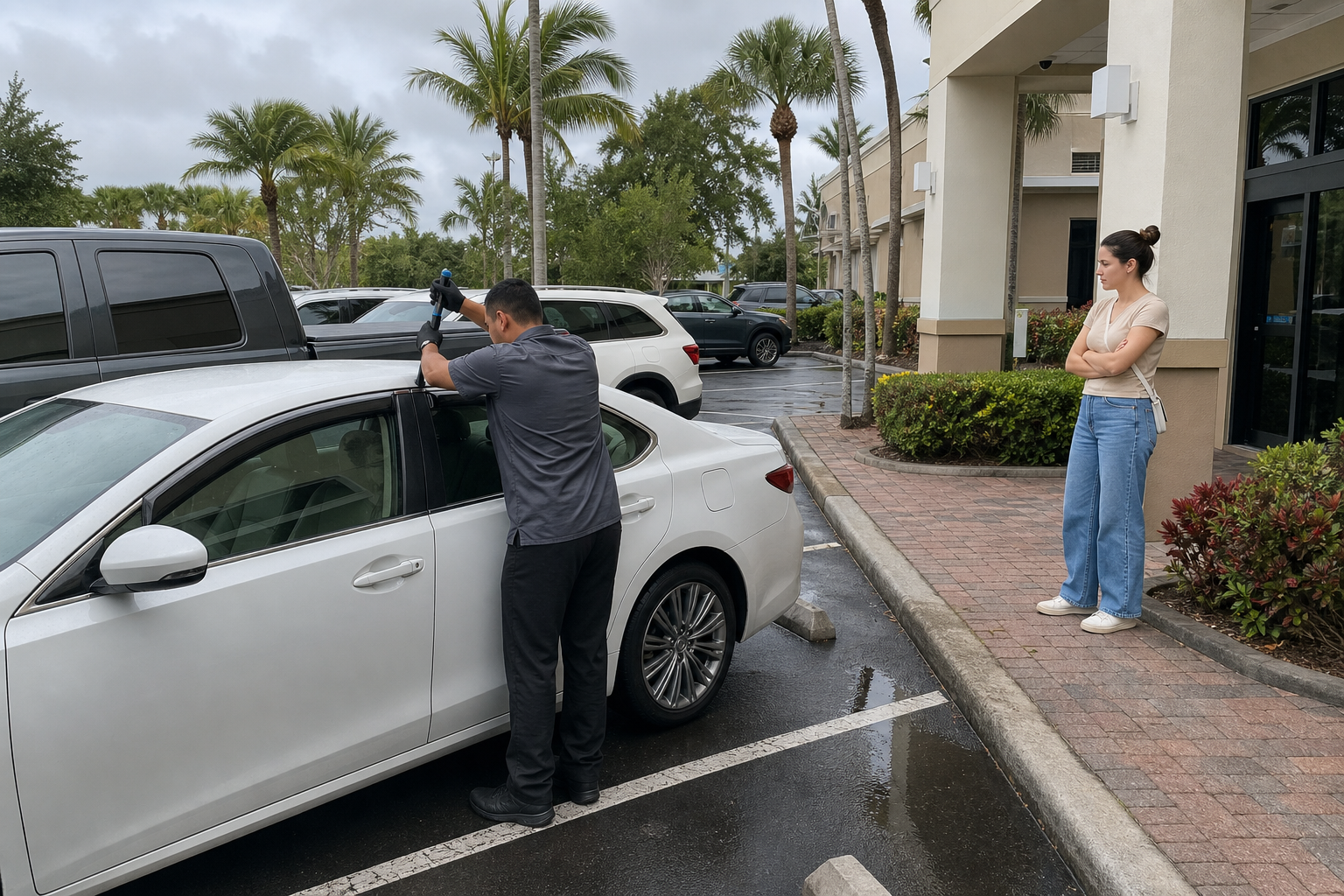
Move out of the vehicle travel lanes, wait at a staffed entrance or another visible sheltered location, and request car lockout service. If a person or animal inside the locked vehicle appears to be in imminent danger, call 911 and follow the dispatcher’s instructions instead of waiting for routine roadside assistance.
Match the lockout situation to the right response
A lockout does not automatically require a tow truck. Use this matrix to separate a routine entry request from a missing-key problem, an emergency, or a vehicle that may be unsafe to drive after access is restored.
| What you see | Priority | Appropriate next step |
|---|---|---|
| The usable key is visible inside, and everyone is safely outside. | Wait away from parking traffic and protect yourself from Florida sun or rain by using an accessible staffed building. | Request car lockout service and describe the vehicle accurately. |
| The key is lost and cannot be located. | Determine whether a spare can be brought to you. | An unlock alone may not make the vehicle drivable. You may need key-replacement support or, if no usable key can be obtained, towing to an appropriate destination. |
| The key or fob is in your hand but will not unlock or start the vehicle. | Check for obvious physical damage to the key. Avoid repeated force or improvised entry attempts. | Explain both the access problem and the possible key, battery, or electronic issue when requesting roadside assistance. |
| A person or animal is inside and showing signs of imminent danger. | Treat this as an emergency rather than a standard lockout. | Call 911, report the condition clearly, and follow dispatcher instructions. Do not independently break glass unless specifically directed in an emergency. |
| The door is opened, but the engine will not start. | Keep the vehicle parked while the cause is narrowed down. | A battery-related no-start may call for jump-start service. An unresolved no-start may require towing. |
| Access is restored, but a tire is flat, fluid is leaking, steering feels abnormal, or a warning indicates a serious fault. | Do not treat the successful unlock as permission to drive. | Request an assessment and discuss flatbed towing if the vehicle cannot be operated safely. |
Stop waiting, continue with service, or change the plan?
Continue with a normal lockout request when all occupants are safely outside, the vehicle is parked without blocking traffic, a working key is locked inside, and you have a safe place to wait.
Change your waiting location if you are standing behind parked vehicles, near active loading, beside an entrance lane, or exposed to uncomfortable Florida heat or rain. A staffed business entrance is generally more useful than remaining beside the car because you can stay visible and tell property staff that assistance is coming. If thunder is present, use a substantial building rather than waiting under a tree or open shelter.
Stop treating the event as a routine service call if an occupant faces imminent danger, you feel threatened, smoke or a strong burning odor appears, or leaking fluid develops around the vehicle. Move to a safer location and contact the appropriate emergency service.
After entry: drive or tow?
Once the door is open, pause before leaving the space. The vehicle may be driven only if you have a usable key, the engine starts normally, the tires appear serviceable, no significant leak is visible, and steering, brakes, and warning indicators do not suggest a serious problem.
Do not drive solely because the doors are open. Towing becomes the better option when the key remains missing, a broken key cannot operate the ignition, the vehicle will not start after suitable roadside help, or its condition makes driving questionable. Tell the provider what changed after entry so the correct equipment can be considered rather than ordering a tow by default.
Parking-lot lockout checklist
- Check access once: Try each door and the trunk or liftgate without forcing anything. Some vehicles unlock only the driver’s door or respond differently to a physical key.
- Mark the vehicle’s position: Note the property name or street address, parking level if applicable, row or section marker, nearest entrance, and vehicle color.
- Notify the property: Ask whether there is a designated service entrance, height restriction, gate procedure, or preferred waiting area.
- Keep your phone usable: Reduce nonessential use, turn up the ringer, and be ready to answer questions from the provider.
- Wait visibly but safely: Do not stand between parked vehicles or directly behind your car. Avoid sitting on curbs bordering active lanes.
- Gather ownership or authorization details: Be prepared to show identification and available documentation once access is restored. Ask the provider what verification is required before service begins.
- Avoid improvised tools: Coat hangers, wedges, and forced window gaps can damage weather seals, glass, locks, wiring, or side-curtain airbag areas.
- Reassess before departure: Confirm that the key works, the car starts, and no separate condition makes driving unsafe.
Prepare the service request without guessing
Give the dispatcher a short, complete description:
- Your location in West Palm Beach, including the property address and exact parking position.
- The vehicle’s year, make, model, color, and body style.
- Whether the engine is running or off.
- Whether the key is visible inside, lost, broken, or in your possession but not working.
- Whether all occupants are safely outside.
- Any gate, garage, clearance, loading-zone, or property-access limitations you observed.
- Any separate no-start, flat-tire, leak, warning-light, or vehicle-damage concern.
Do not describe a missing key as merely “locked inside.” Entry service may open the vehicle but cannot make it drivable without a usable key. Likewise, disclose a low-clearance garage or restricted entrance before equipment is sent. Accurate information helps distinguish a straightforward unlock from a roadside diagnosis or conditional tow.
Questions drivers ask while locked out
Should I remain beside the car?
Not if doing so places you near reversing vehicles, active lanes, loading activity, or exposed conditions. Wait at a visible staffed location when available, tell property personnel which vehicle is yours, and keep your phone on.
Can roadside assistance make a replacement key?
Do not assume it can. Vehicle-entry service and key replacement are different tasks. If the key is lost, explain that before dispatch so you can determine whether to arrange a spare, seek key-specific help, or tow the vehicle.
When does a parking-lot lockout require towing?
Towing is conditional. Consider it when no usable key can be obtained, the vehicle cannot be started after appropriate roadside assistance, or a separate tire, leak, steering, brake, or warning condition makes driving unsafe.
What if a pet is locked inside?
Observe the animal’s condition without delaying action. If it appears to face imminent danger, call 911 and follow dispatcher instructions. If there is no sign of imminent danger, request lockout help promptly, remain available, and continue monitoring from a safe position.
Should I try to open the door with a wire or wedge?
No. Improvised entry can turn a lockout into glass, paint, seal, wiring, or airbag-area damage. Use a service equipped for vehicle entry.
Choose help based on what happens next
Key locked inside and everyone safe: request lockout service. Door open but battery appears discharged: request a jump start. No usable key or the vehicle is not safe to operate: discuss towing to an appropriate destination. Imminent danger inside the vehicle: call 911 and follow dispatcher directions.