
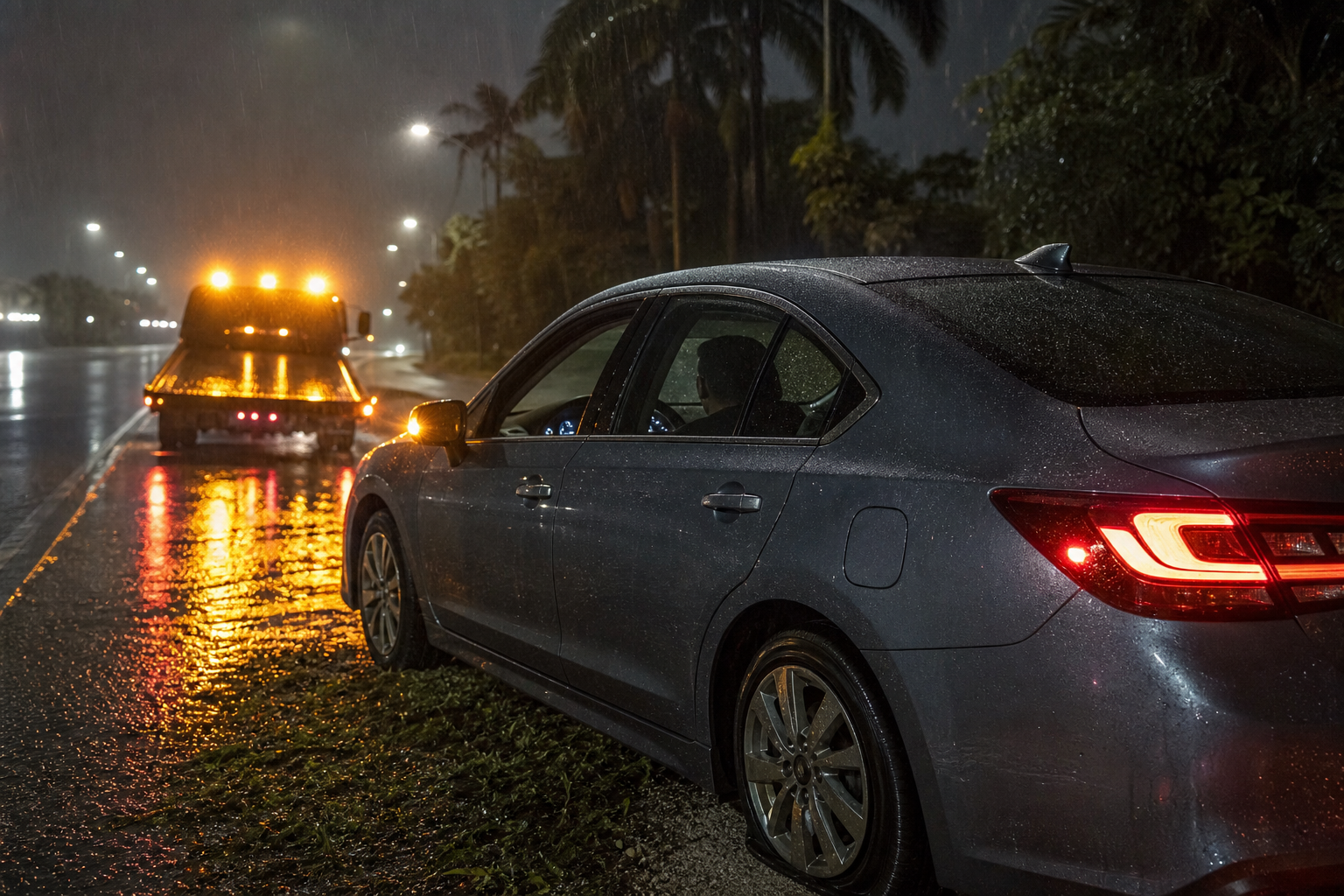
The highest-risk mistake is getting out immediately to inspect or change the tire beside moving traffic. Heavy rain reduces visibility, masks vehicle noise, and makes wet shoulders difficult for approaching drivers to read—especially at night. The safer alternative is to control the vehicle, reach the best available stopping place without forcing a damaged tire farther than necessary, and assess the situation from inside before opening a door.
Symptom and situation matrix
Use what you felt, heard, or saw before stopping. Do not step into traffic or kneel beside the vehicle simply to confirm a diagnosis.
| What you notice | What it may mean | Best next action |
|---|---|---|
| A sudden bang, rapid thumping, pulling, or strong vibration | A blowout, separated tread, or severely deflated tire | Stop as soon as a safer location is reachable. Do not continue toward your destination. Request flat tire service if the car is safely positioned and has a usable spare; otherwise request towing. |
| A tire-pressure warning with normal steering and no unusual sound | Pressure loss ranging from gradual to active | Reduce speed and move to a safe stopping place for assessment. Heavy rain can hide a visibly low tire, so do not assume the warning is harmless. |
| Steering feels soft, the car drifts, or vibration grows | A tire may be losing air quickly | Treat this as an active tire failure. Avoid sudden inputs and stop rather than testing how far the tire will last. |
| A low tire is visible, but the vehicle is parked away from traffic | A puncture, valve leak, or other pressure loss | Remain inside if rain or darkness makes a roadside change unsafe. Call roadside assistance and describe the parking surface, tire position, and spare-tire status. |
| The wheel appears bent, the tire is torn, or the vehicle struck a pothole or debris | Damage may extend beyond a simple puncture | Do not install a spare merely to keep driving if the wheel or surrounding area appears damaged. Ask whether flatbed towing is the appropriate transport option. |
| Water is rising around the stopped vehicle | The location itself is becoming the primary danger | Do not focus on the tire. Contact emergency services and follow their instructions about moving to a safer location. |
Stop or continue? Make the decision in this order
Stop without extending the drive when:
- You heard a bang or repeated thumping.
- The vehicle pulls, shakes, or no longer responds normally.
- The tire looks collapsed or damaged from your seated position.
- You smell rubber or hear scraping.
- Continuing would require normal road speed on a suspected flat.
Driving on a flat can turn a serviceable tire problem into wheel damage and can reduce control. “Just a little farther” is not a safe plan when the car is already shaking or pulling.
Move only far enough to reduce immediate exposure when:
- You are stopped in an active travel lane.
- The shoulder is too narrow for the vehicle.
- You are on a curve, crest, or other location where approaching drivers may not see you.
- Standing water or unstable ground threatens the stopping area.
This is not permission to drive to a preferred destination. If the vehicle still rolls predictably, use slow, controlled movement to reach the nearest meaningfully safer position. Stop immediately if steering or stability worsens.
Do not resume the trip merely because:
- The pressure warning turns off.
- The rain makes inspection inconvenient.
- The tire looks only slightly low through a wet window.
- A spare is present but the roadside location is unsafe for changing it.
Rain-and-darkness roadside checklist
Secure the vehicle
- Shift into Park, apply the parking brake, and leave the hazard warning lights on while stopped.
- Turn the front wheels away from the traffic side when practical, but do not reposition a vehicle that is already unstable.
- Keep occupants belted and doors locked while arranging help.
- Do not stand behind or directly in front of the vehicle.
Judge the location before opening a door
- Look for moving traffic, standing water, soft ground, drainage flow, and limited sight distance.
- At night, assume drivers may notice the vehicle later than expected. Rain glare can make vehicle outlines and people difficult to distinguish.
- If an exit is necessary and clearly safer than remaining inside, use the side farthest from traffic when accessible. Move well away from travel lanes rather than waiting beside the tire.
- Never place your body partly beneath the vehicle, and do not use a jack on soft, sloped, flooded, or unstable ground.
Decide whether a tire change is realistic
A spare tire does not make every location suitable for a roadside change. You need stable ground, adequate separation from traffic, enough visibility, the correct equipment, and confidence using it. Heavy rain or nighttime exposure can make professional service the better choice even when the tire problem itself is straightforward.
Preserve phone power and location details
- Lower screen brightness and connect a charger if available.
- Use the phone’s map pin or location-sharing function rather than guessing your position.
- Keep the phone dry and audible so the service provider can reach you.
Prepare the service call before dialing
An information-ready request helps a dispatcher determine whether you need a tire change, roadside support, or a tow. Gather what you can without leaving the vehicle:
- Your map location, nearby address, or clearly visible cross street.
- Vehicle year, make, model, color, and body style.
- Which tire is affected: front or rear, driver or passenger side.
- Whether the tire is low, fully flat, shredded, or separated from the wheel.
- Whether the wheel appears bent or the car contacted debris.
- Whether you have a spare, jack, and wheel-lock key—and whether the spare is accessible.
- Whether the vehicle is in a lane, on a narrow shoulder, in a parking area, or near standing water.
- The number of occupants and any mobility or personal-safety concerns.
Also mention heavy rain and low nighttime visibility at the beginning of the call. If the car cannot be safely serviced where it sits, ask for 24-hour towing rather than assuming a roadside tire change is possible.
Ready to call? State your exact location first, then say: “I have a tire problem in heavy rain. The vehicle is [in/out of] a travel lane, the [tire position] is [flat/damaged], and I [do/do not] have a usable spare.”
Frequently asked questions
Should I stay inside the car while waiting?
If the vehicle is fully out of traffic and the surrounding area is not threatened by water or another hazard, staying belted inside is often safer than standing beside the car in heavy rain. If the vehicle may be struck or water is rising, contact emergency services and follow their instructions.
Can roadside assistance patch the tire in the rain?
Service depends on the tire’s condition, the equipment available, and whether the location provides a safe working area. A torn sidewall, damaged wheel, unstable surface, or exposed roadside position may require towing instead of on-site work.
Can I drive slowly on a flat tire to reach shelter?
Do not continue a normal trip on a flat. If remaining where you are creates an immediate traffic hazard and the vehicle still responds predictably, move only the minimum distance needed to reach a meaningfully safer position. Stop if control worsens.
What if I have a spare but do not feel safe getting out?
Stay inside, lock the doors, and request help. Tell the provider that you have a spare but that rain, darkness, traffic exposure, or the ground surface makes a self-change unsafe. Having the spare available can still help the service provider plan the call.